
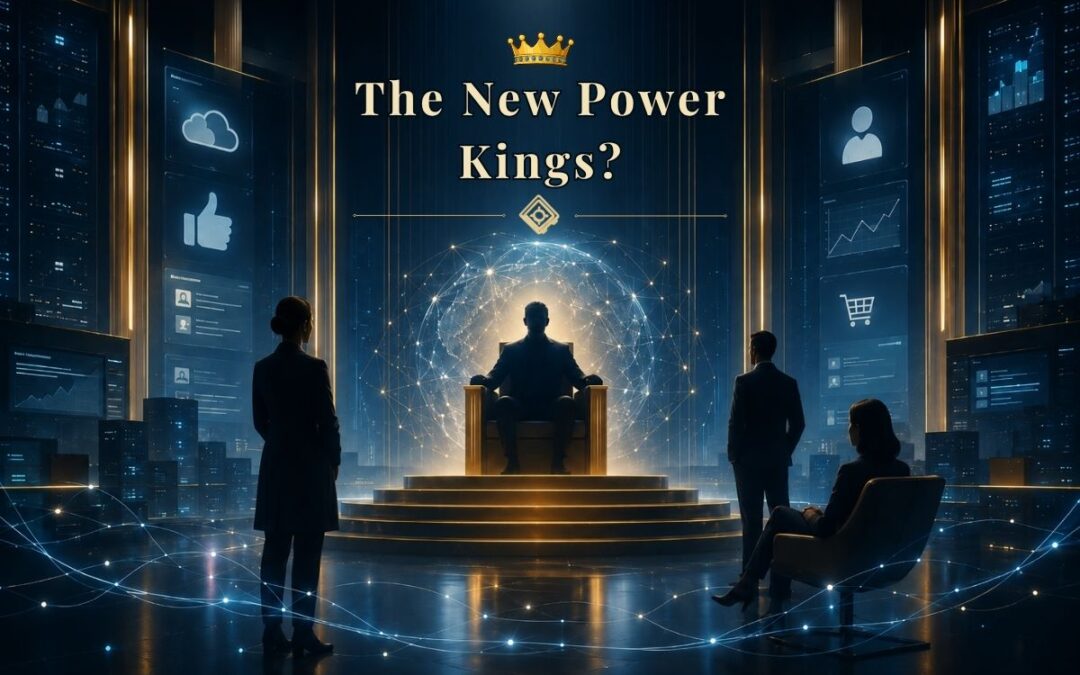
Who Controls the Future of AI?
King Elon and his digital servants? A few billionaires and their giant data centers? Or could the future also belong to people who are willing to learn, think, build and take responsibility for their own lives?
Maybe the truth is more interesting
When people talk about artificial intelligence, the discussion often moves very quickly into two opposite directions.
Some believe AI will save the world. Others believe that a handful of billionaires will control everything. You hear sentences like: “In the end, everything will belong to Elon Musk.” Or: “We will all become servants of the big technology companies.”
I understand why people think that way. The big companies are building enormous data centers. They are investing billions. They are developing systems that are difficult for normal people to understand, let alone control.
But at the same time, something else is happening. Something that is easy to overlook.
These tools are also arriving in the hands of ordinary people.
Tools in your own hands
Not long ago, artificial intelligence was a topic for research departments, universities and large companies with serious money behind them. If you wanted to work with AI, you needed special knowledge, expensive technology and access to systems that were far away from normal everyday life.
Today, things are changing.
A laptop, a stable internet connection and the right tools are already enough to write texts, create images, structure ideas, plan websites, prepare simple videos or automate parts of your work.
Not perfectly. Not magically. Not always correctly.
But often surprisingly well.
Suddenly, one person can prepare things that used to require a whole team. A small business owner can write better offers. A retiree can finally bring an old idea into shape. Someone who moved abroad can share real experiences in a blog. A small community can explain more clearly what it stands for.
AI does not automatically replace people. But it can make people stronger when it is used with awareness, patience and common sense.
New power centers and lower barriers
Of course, it would be naive to pretend that everything about AI is free, open and harmless.
The strongest AI systems cost a lot of money. Data centers need energy, hardware and capital. Not everyone can train large models. Not everyone has access to the best infrastructure. And yes, large corporations will try to increase their influence.
That is not new.
We have seen something similar with the internet. In the beginning, it felt open, wild and full of small projects. Later, the big platforms arrived. Google, Facebook, Amazon, Apple, Microsoft and many others made many things easier, but they also centralized a lot of power.
AI will probably follow a similar path.
On one side, a few large companies will build the strongest machines. On the other side, thousands of smaller tools, local models, open source projects, tutorials, automations and creative solutions will appear.
And that is where things become interesting.
Not everybody has to become an AI researcher. But many people can learn how to use these tools in a practical way.
The real question
For me, the most interesting question is not whether Elon Musk, Sam Altman, Google or some other company will control the world.
The more important question is much closer to everyday life:
„`What can I do with the possibilities that are already available today?
What can help me work more clearly?
What can make me more independent?
What can save time?
What should I not hand over too easily?
Technological changes have always reshaped the world. Steam engines, electricity, cars, computers, the internet. Every major change created winners, losers, new jobs, new dependencies and new freedoms.
Artificial intelligence may do the same.
You can be afraid of it. That is understandable. You can reject it completely. That is also a decision. Or you can begin to understand it. Not blindly. Not like a believer who thinks every new tool is wonderful. But awake, critical and practical.
AI is not automatically freedom. But it can support freedom if people use it consciously.
„`Not only screens and future talk
Still, I do not believe that the future should consist only of screens, programs and automations.
Actually, I believe the opposite.
The stronger the digital world becomes, the more important the real world becomes.
A garden. A simple meal. A walk with the dogs. A conversation at the table. Soil under your fingers. Wood in the workshop. Coffee that did not come from a capsule, but from a plant.
That may sound old fashioned.
I do not think it is.
It is grounding.
What is the use of the best AI system if you lose yourself while using it? What is the use of a perfect digital workflow if your body is tired, your mind never rests and your life only feels like another task list?
Maybe we need both.
Modern tools and a simpler life. Digital possibilities and real community. Artificial intelligence and natural surroundings. Progress and a bit of common sense.
A quiet place in the highlands of Panama
Maybe you are not only looking for new digital tools. Maybe you are also looking for a real place where you can slow down again.
A place where nature, community and self determination are not just nice words.
In the highlands of Panama, such a place has grown over many years. Not as a luxury resort. Not as a hotel complex. Not as a glossy expat dream.
It is simply a living place for people who want to live independently, but do not want to be completely alone.
Here, you can stay in an apartment within the community, find some peace, work on your own projects or simply experience what everyday life in this part of Panama really feels like.
Expats, people thinking about relocation, quiet nomads and people with new life ideas can meet here. Not as a forced community. More as a possibility.
You can withdraw when you need quiet. And you can take part when you feel like it.
Digital and analog life together
For me, the interesting part is the combination.
You can work on an AI project in the morning, write texts, organize ideas or build small automations. Later, you can walk through coffee fields, help in the garden, sit outside or go for a walk with the dogs.
This is not about sitting in front of a screen all day.
It is about connecting digital possibilities with real life.
Those who like practical work can help with planting on the coffee finca. In the greenhouse, there is always something to do. Preparing beds, caring for plants, learning how vegetables grow in this climate, or simply being part of the daily rhythm.
There is gardening, small building work, repairs and many practical things where helping hands are welcome.
In the wood workshop, ideas can become real objects. Sometimes something useful. Sometimes something beautiful. Sometimes just a first attempt that is far from perfect. But that is often how things start. You try, you learn, you improve.
Metal work and welding are also possible. Sometimes for repairs. Sometimes for special pieces. Sometimes just because someone has an idea and wants to see whether it can be done.
If you are more creative, nature gives enough inspiration. Writing, painting, taking photos, making small videos or simply collecting thoughts. Not everything has to be sold, optimized or published immediately. Sometimes it is enough to create something.
And then there are the simple shared things. Trying new recipes. Cooking together. Eating together. Talking. Laughing. Realizing that the meal was pretty good, or that next time we should do it a little differently.
That is also life.
Self determination instead of dependence
This is the key point for me.
The future of AI will not only be decided in the offices of large corporations. It will also be shaped wherever normal people begin to use these tools consciously.
Not as blind consumers.
Not as servants of some digital king.
But as people who say:
„`I will learn this.
I will use this.
I will check this.
I will decide what belongs in my life.
Of course, this requires attention. AI can make mistakes. It can create dependency. It can pull you into directions you did not consciously choose.
But that is true for many tools.
A knife can cut bread or hurt someone. A car can give freedom or trap you in traffic. The internet can bring knowledge or distract you for hours.
The question is not only what the tool can do.
The question is who is holding it.
„`Why community matters
Learning alone is possible. But many things become easier when people can learn together.
Especially with new technologies, it helps to have people around you who ask questions, share mistakes, test ideas and talk about progress in a normal human way.
Not everyone has to know everything.
One person understands technology better. Another has a feeling for words. Someone has practical building experience. Someone can cook well. Someone knows plants. Someone brings calm into a discussion.
That is how a community can become useful without everyone needing to be perfect.
We do not all have to become programmers. We do not all have to become influencers, coaches or technology experts.
But we can learn to connect our abilities.
One person works on the laptop. Another works in the garden. Later, people sit together at the table and suddenly notice that both things belong together.
A more independent life does not come only from technology. It also comes from knowledge, practical skills, clear decisions, good conversations and people you can rely on.
Not leaving the world behind
Living in the highlands of Panama does not mean hiding from the world.
For me, it means finding a better distance.
You are not gone from the world. You are simply not standing in the middle of all the noise anymore.
You can still inform yourself, learn, work, write, build and use digital tools. But after that, you can go outside, hear the rain, see plants growing, eat with people or simply have a moment where nothing has to be done.
That mixture has become rare.
Many people today are either completely overstimulated by the digital world or dreaming of a simple life that does not fit their reality.
Maybe the answer is somewhere in between.
Not back into the past. Not blindly into the future. But consciously into the present.
With technology when it helps. With nature when it heals. With community when it carries you. With quiet when you need it.
The future does not automatically belong to the loudest voices
Maybe the big AI companies will become extremely powerful. Maybe some people will become unbelievably rich. Maybe some dependencies will grow stronger than we would like.
We should not ignore that.
But it does not automatically mean that normal people no longer have a chance.
On the contrary.
This may be exactly the time to stay awake. To learn. To test. To build small systems of your own. To create content. To gather knowledge. To strengthen practical skills. To build communities.
Not out of fear.
But out of self determination.
The future does not automatically belong to Elon Musk. It does not automatically belong to any other company either.
It also belongs to people who are willing to take responsibility for their tools, their time, their body, their community and their life.
An invitation from Panama Community
Artificial intelligence will change many parts of our lives. I have little doubt about that.
The real question is whether we allow ourselves to be pushed around by these changes, or whether we begin to deal with them consciously.
Maybe you would like to think more about AI, self determination, community, relocation, nature, a simpler life and the question of how to find your own path in this strange and fast moving time.
In our newsletter, we share thoughts, experiences and developments from Panama Community. Not as glossy promises. Just calmly, honestly and from real everyday life in the highlands of Panama.
Because maybe the future does not always begin where the largest server halls are built.
Maybe it also begins at a simple table, with a good conversation, an idea, a laptop, a garden outside the door and people who want to shape their lives again.
Open the Contact Form